
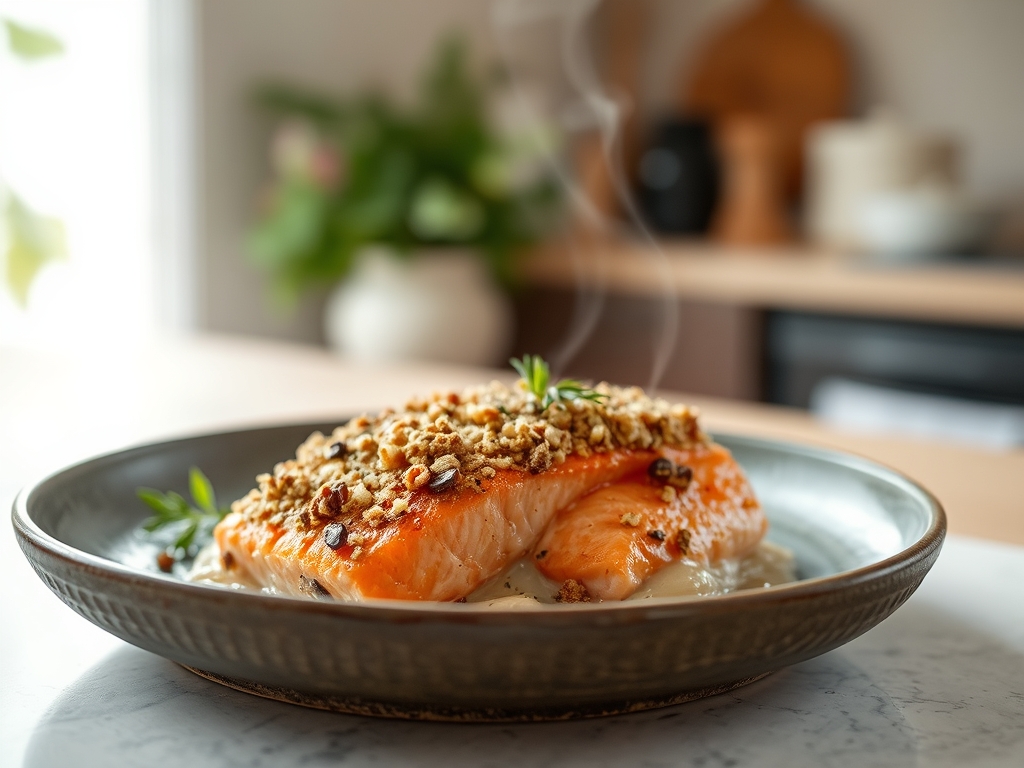
Imagine the sound of a heavy bottomed skillet hitting the burner; a resonant, metallic ring that signals the start of something transformative. You are standing in your kitchen, the air cool and expectant, holding a fillet of cold, marbled fish. The goal is simple: we are chasing the ultimate textural contrast. When you master walnut crusted salmon recipes, you are playing a game of thermal dynamics. You want the interior to remain a translucent, buttery medium rare while the exterior develops a jagged, toasted architecture. It is the kind of dish that makes you feel like a culinary architect. We are not just cooking dinner; we are engineering a sensory event where the earthy, tannic crunch of the nut meets the fatty, saline silk of the sea. This is about more than just a meal. It is about the chemistry of the crunch and the science of the sear.
The Gathers:
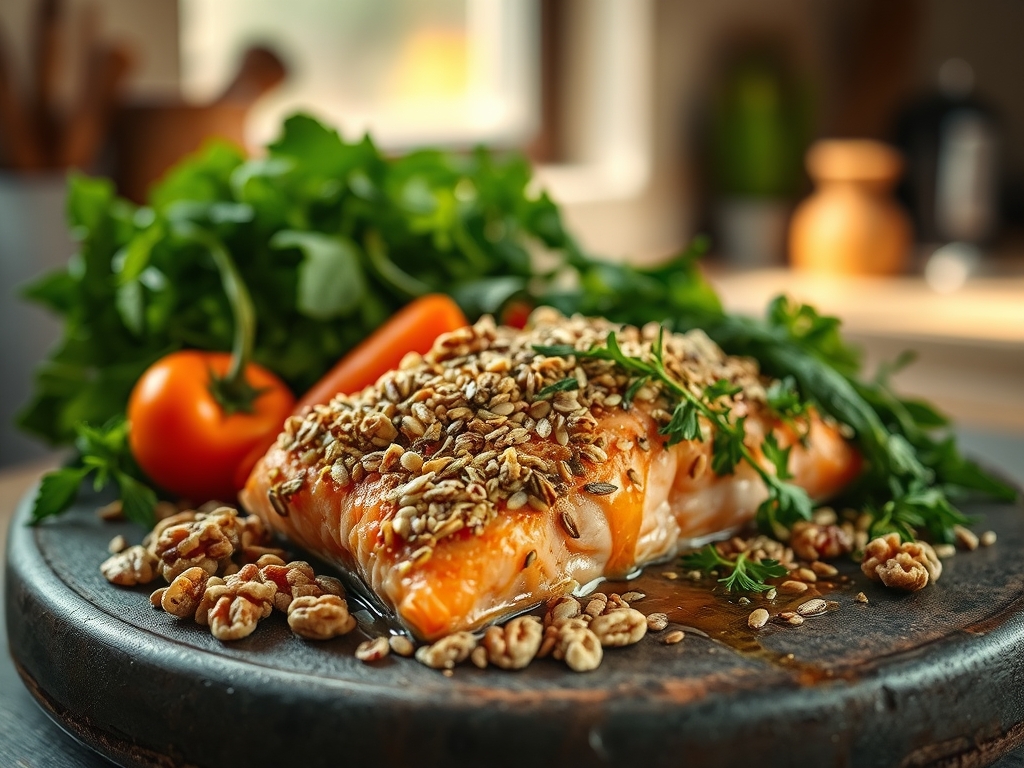
To execute this properly, your mise-en-place must be precise. Start with center-cut Atlantic or King salmon fillets. You need the uniform thickness to ensure even heat distribution. For the crust, reach for raw walnut halves. You will use a sharp chef knife to hand-mince them; do not use a food processor, as the high speed can express the oils prematurely and turn your crust into a paste. You want discrete, angular fragments that provide maximum surface area for browning.
Next, we need a binding agent. A high-quality Dijon mustard acts as an emulsifier, providing a viscous layer that grips the nuts. Add a touch of honey for its hygroscopic properties; it attracts moisture and aids in the Maillard reaction. For aromatics, use a microplane to zest a fresh lemon, releasing the volatile oils trapped in the flavedo. Finally, grab some panko breadcrumbs to aerate the mixture.
Smart Substitutions: If you are avoiding gluten, swap panko for crushed pork rinds or almond flour. If you want a more piquant profile, swap the honey for maple syrup or even a dash of miso paste to infuse the dish with deep umami.
The Clock:
Efficiency in the kitchen is about "Chef's Flow." This is the psychological state where your movements are economical and your timing is synchronized. The total preparation time is exactly 12 minutes. This includes the time to pat the fish dry, mince the walnuts, and whisk your binder.
The cooking phase requires 10 to 14 minutes depending on the thickness of your fillets. We operate on a 400 degree Fahrenheit baseline. Remember that your oven is a convection environment; air must circulate freely. If you crowd the pan, you create steam, which is the enemy of the crunch. Total time from fridge to table is under 30 minutes, making this a high-yield, low-effort masterpiece.
The Masterclass:
1. The Desiccation Phase
Use a paper towel to aggressively pat the salmon dry. Moisture on the surface of the fish will absorb thermal energy as it evaporates, preventing the crust from adhering. A dry surface allows the proteins to bond immediately with your binder.
Pro Tip: This is known as surface desiccation. By removing water, you ensure that the heat of the oven goes directly into crisping the walnuts rather than boiling the surface of the fish.
2. The Emulsion Application
Whisk your Dijon, honey, and lemon zest in a small saucier or bowl until the mixture is glossy and thick. Use a silicone pastry brush to apply a thin, even layer to the top of the salmon. You are looking for a "tacky" finish, not a puddle.
Pro Tip: The mustard acts as a surfactant. It lowers the surface tension between the oily fish and the dry nut topping, creating a structural bridge that prevents the crust from sliding off during service.
3. The Walnut Architecture
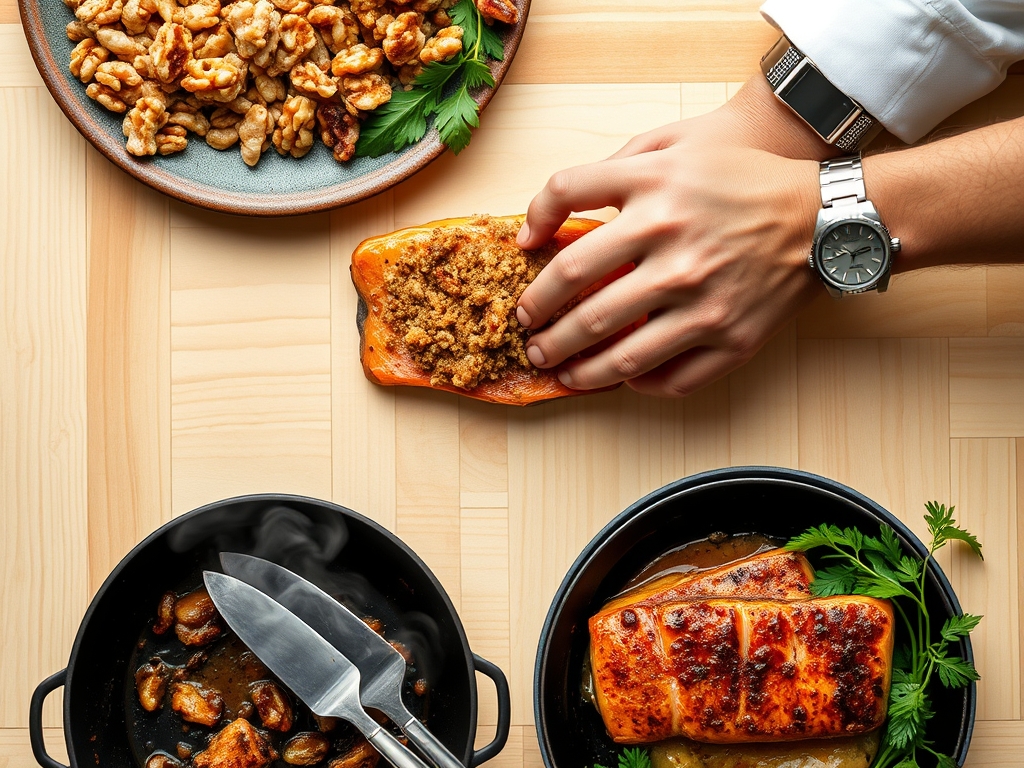
Press the minced walnuts and panko firmly into the mustard layer. Use the flat side of a bench scraper to level the top. You want a flat, even plateau of nuts so the heat hits every fragment simultaneously.
Pro Tip: This creates an insulation barrier. The nuts protect the delicate fish proteins from direct radiant heat, allowing the salmon to "poach" in its own fats while the exterior toasts.
4. The Thermal Transition
Place your fillets on a parchment-lined sheet pan. Slide them into the center rack of the oven. If you have a digital scale, ensure your fillets are roughly 6 ounces each for consistent timing.
Pro Tip: Watch for the "white beads" of albumin. If you see too much white protein escaping the fish, your temperature is too high. This is a sign the muscle fibers are contracting too violently and squeezing out moisture.
5. The Carryover Rest
Remove the salmon when the internal temperature hits 130 degrees Fahrenheit. Use a metal spatula to transfer them to a warm plate. Let them rest for exactly three minutes before serving.
Pro Tip: This utilizes thermal carryover. The internal temperature will rise another 5 degrees while resting, reaching a perfect 135 degrees. This allows the juices to redistribute through the lamellae of the fish.
6. The Acid Finish
Just before the plate hits the table, use a microplane to grate fresh horseradish or extra lemon zest over the top. The hit of cold, fresh acid cuts through the heavy lipids of the walnuts.
Pro Tip: This is a "top-note" application. Volatile aromatic compounds dissipate quickly in heat, so adding them at the very last second ensures the diner receives the full olfactory impact.
The Deep Dive:
From a macro perspective, this dish is a powerhouse. You are getting high-density Omega-3 fatty acids from both the salmon and the walnuts. It is a heart-healthy, brain-boosting meal that feels indulgent but remains functionally clean.
Dietary Swaps: For a Keto version, eliminate the honey and panko, using extra walnuts and a pinch of parmesan cheese for the "crunch" factor. For a Vegan version, this crust works beautifully on a thick slab of roasted cauliflower or a firm block of tofu.
The Fix-It:
- Soggy Bottoms: If the bottom of the fish is wet, you likely didn't dry it enough or you used a glass baking dish. Switch to a metal sheet pan for better heat conduction.
- Burnt Nuts: If the walnuts are darkening too fast, tent the fish loosely with foil. This reflects radiant heat while allowing the interior to finish.
- The Slide: If the crust falls off, your binder was too thin. Add more mustard or a teaspoon of mayo to increase the viscosity.
Meal Prep: To reheat, avoid the microwave. It will turn the salmon into rubber and the walnuts into mush. Instead, use a toaster oven at 300 degrees for 8 minutes. This gently wakes up the fats without overcooking the core.
The Wrap-Up:
You now hold the keys to a restaurant-quality dinner that relies on physics as much as flavor. Walnut crusted salmon recipes are the perfect intersection of healthy fats and sophisticated textures. By focusing on surface desiccation and thermal carryover, you have elevated a simple fillet into a technical triumph. Go forth, use your tongs with confidence, and enjoy the crunch!
The Kitchen Table:
How do I keep the walnut crust from falling off?
Ensure the salmon surface is bone-dry before applying your binder. Use a thick emulsifier like Dijon mustard or a honey-mustard blend. Press the nuts firmly into the fish using a flat spatula to lock them into the viscous layer.
Can I make walnut crusted salmon in an air fryer?
Yes. Set the air fryer to 375 degrees Fahrenheit. The high-velocity air is excellent for crisping the walnut exterior. Cook for 8 to 10 minutes; however, be careful as the light panko might blow around if not pressed firmly.
What is the best way to tell if the salmon is done?
The most accurate method is using a digital thermometer to find a 135-degree internal temperature. Visually, the fish should be opaque on the sides and flake easily with a fork while remaining slightly translucent in the very center.
Should I leave the skin on the salmon?
Always keep the skin on during the cooking process. It acts as a thermal buffer, protecting the flesh from the hot pan. You can easily slide the skin off with a spatula after cooking if you prefer not to eat it.